
Τhe field of Molecular Biology aims to explain how the DNA and particularly our genes define our body. Someone could easily suppose- based on basic Biology knowledge- that all the characteristics we inherit to our children, are passed through our genome. But could someone ever imagine that there is something more than that?

Actually, the answer to this question is being studied by a relatively new field of Biology, which is called Epigenetics. The field of Epigenetics began as a broad combined research on Genetics and Developmental Biology and during the last decades has turned to be one of the most intriguing trends in Life Sciences. The term “Epigenetic” was first introduced in 1942 by C. H. Waddington, one of the founders of Systems Biology and Evolutionary Biology, and derives from the greek word “epigenesis” which describes the interaction between gene function and environment.
The main idea of Epigenetics is the study of how the environment and individual lifestyle can affect the gene function and as a result how this reflects to the next generations. The growing interest in Epigenetics derives from the fact that new findings suggest a correlation between epigenetic changes and various disorders, such as immune disorders, neuropsychiatric disorders, obesity and various types of cancer.
Based on this, epigenetics is a field of study for reproductive biology as well. It is estimated that about 20% of the infertility cases are unexplained. Now, we can assume that some of these cases are a result of epigenetic modifications. These kinds of modifications happen at the level of the DNA. Particularly, some environmental and other external factors have the ability to alter the gene expression. The thin line in this subject is that the modification does not occur by changing the sequence of a gene, but by “switching it on or off”. There are several mechanisms that can lead to epigenetic modifications, but currently the most studied is a mechanism called “DNA methylation”. The methyliation of the DNA is a regulatory mark in particular sites in DNA, that are called CpG islands and occur in gene regulatory sequences.
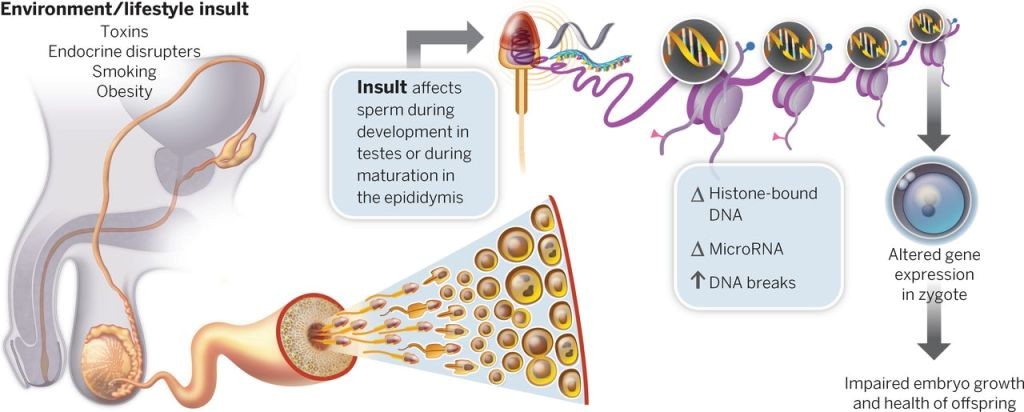
DNA methyliation for example can affect genes which are associated with the ability of the spermatozoa to “find” or penetrate the egg, or can cause poor/ abnormal embryo development.
An interesting fact is that this abnormal methylation may be present, even when all the semen parameters appear normal (e.g. count, morphology, motility). As a result a simple semen analysis is not enough to detect these cases. Hopefully, the advance of epigenetic studies, is nowadays a key to all this infertility cases, which were unexplained since the near past. Promising developing diagnostic technologies can nowadays recognize the epigenetic marks.
As a result, improved IVF outcomes are expected, as a men’s fertility status can now be assessed with a more complete and detailed diagnosis, than it used until now. In addition, another interesting fact is that epigenetic modifications are progressing processes that may be reversible. Therefore, these modifications may serve as potential targets for treatment and diagnosis, obtaining quantitative information through suitable analysis.

In addition, epigenetic mechanisms seem to be correlated with female factors as well. Epigenetic modifications are involved in the control of different genes which cause morphological and functional changes of the endometrium during the menstrual cycle. As a result, this fact suggests that epigenetic changes may be associated with cases of implantation failure, early pregnancy pathologies, or endometrial pathologies.Of course, further research in the field of Epigenetics is required. But in order to completely understand how epigenetics influences a child, it is important to study both the paternal and maternal effects, as well as their interactions.
All these new scientific discoveries arise new aspects in the treatment of an infertile couple, as recommendations or lifestyle alternations may be proposed. In addition the physician could make the best IVF choice, personally according to each couple’s unique case. In that way, the desire of having a baby can be fulfilled by the best and most successful methods.

Τατιάνα Χαρτοματσίδου | BcS, MSc
Jr. Clinical Embryologist